

Navigating bruxism · The interactive guide
Grinding wears you down.
Everything your dentist would tell you about bruxism — and the custom guard that stops the damage tonight.
1 in 5 of us grind or clench in our sleep, and most only find out from the damage. Ten minutes here and you'll know the signs, what's driving it, and exactly how to protect your teeth.
4.9 average review·Trusted by 1,000,000+ smiles·100% Money-Back Smile Guarantee





Bruxism, chapter by chapter
Everything your dentist would tell you, in five short chapters. Tap through — then check yourself against the signs below.
The habit you can't catch yourself doing
/ˈbrək-ˌsi-zəm/ · noun
The involuntary grinding, clenching, or gnashing of teeth — awake or, most often, asleep.
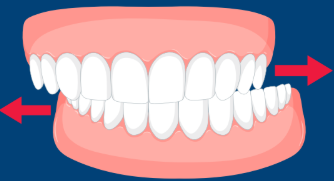
Most bruxism happens at night, which is why it goes unnoticed for years: you can't catch yourself doing something you sleep through. The first clues are usually secondhand — a partner who hears it, a dentist who spots flattened enamel, a morning headache that keeps coming back.
It isn't rare, and it isn't a character flaw. It's your nervous system parking tension in your jaw — day or night, and it's remarkably common worldwide.
of the global population suffers from daytime or nighttime bruxism.
as common in women as in men. Antidepressants — a known bruxism trigger — are also prescribed to women 2:1.
From “Navigating Bruxism,” the Smile Brilliant guide.
Where grinding shows up first
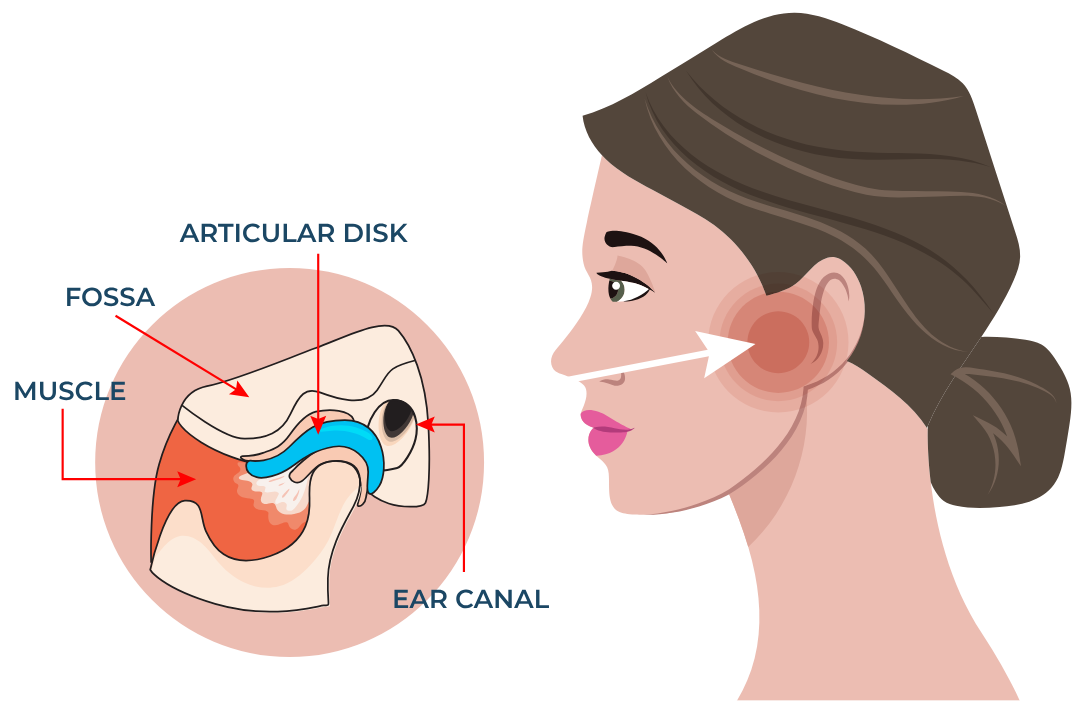
The most common symptom of bruxism is trouble in the temporomandibular joint — the TMJ, the hinge that connects your jaw to your skull.
Meet your TMJ — the joint that takes the hit
Every clench loads this joint and the muscles around it. And because the TMJ sits directly in front of your ear canal, grinding pain shows up in unexpected places.
No single cause — seven usual suspects
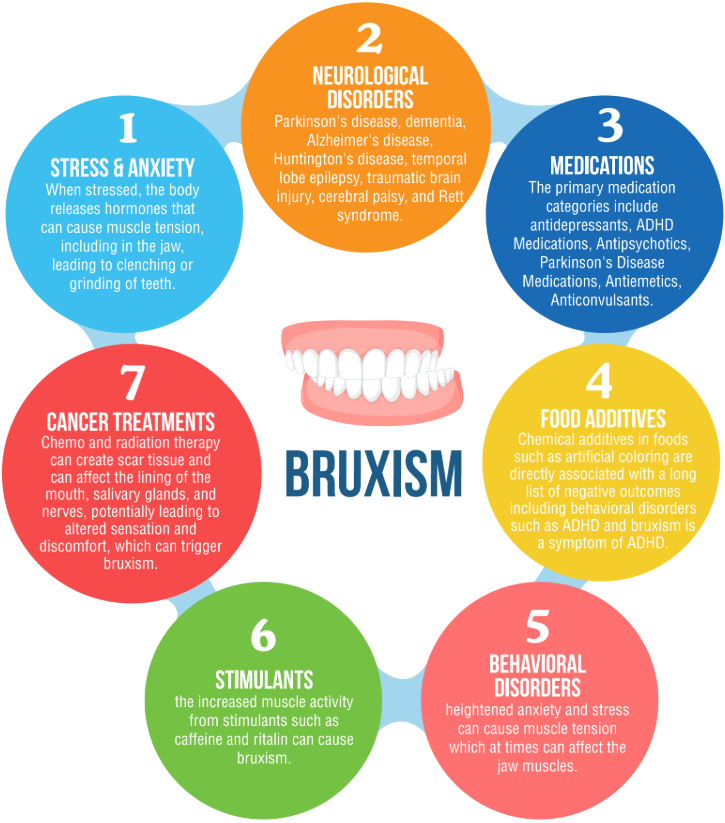
No single factor is responsible for all bruxism, and most grinders have more than one. Tap through the most common drivers.
The #1 driver: a jaw stuck in fight-or-flight
When you're stressed — a hard week or long-term anxiety — your body's fight-or-flight response activates the sympathetic nervous system. That response raises involuntary muscle tension, and the muscles that close your jaw are some of the strongest in your body.
Your teeth take the tension out overnight, when you can't consciously release it.
A documented side effect of common prescriptions
Bruxism is a known side effect of several widely-prescribed medication categories. If your grinding started around a new prescription, that's worth a conversation with your doctor — never a reason to stop on your own.
Grinding fuel, especially after lunch
Stimulants increase brain activity — and with it, hyperactivity in the jaw muscles. Caffeine is the one most of us are dosing daily; late-day coffee and energy drinks follow you into your sleep.
Strongly associated with ADHD and autism
Studies indicate a significant association between behavioral disorders and bruxism — heightened anxiety and stress tense the same jaw muscles.
When motor control is affected
A number of neurological conditions can cause bruxism or commonly travel with it.
The long way around: additives → ADHD → bruxism
Little research links food additives to bruxism directly — but additives are associated with ADHD, and 31% of people with ADHD grind. Ultra-processed diets keep showing up adjacent to the problem.
An under-discussed effect of treatment
Radiation therapy near the head or neck can harden and scar tissue (radiation fibrosis) and affect the mouth's lining, salivary glands, and nerves. The altered sensation and discomfort that follow can trigger grinding; chemotherapy can do the same.
Whatever the cause, the damage happens the same way — tooth on tooth, night after night. A custom guard breaks that contact while you work on the root cause. Read the full causes guide.
See the fix250 lbs of force, every night
A grinding jaw can load your teeth with up to 250 lbs of force — and enamel loses that fight every time. Untreated, the damage runs in stages. The later stages don't reverse.
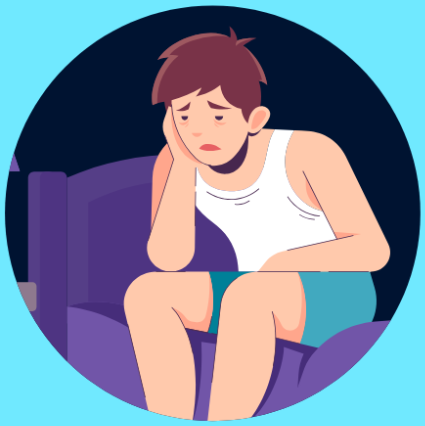
Enamel wear & sensitivity
Enamel thins where teeth meet; hot, cold, and sweet start to sting.
PreventableChips, cracks & cavities
Teeth flatten, chip, and crack — cavities and periodontal disease take hold where enamel has failed.
CostlyHeadaches & poor sleep
Temple headaches and jaw pain set in; grinding itself starts disturbing your sleep.
ChronicTMJ, misalignment & tooth loss
Constant friction slowly shifts teeth out of position — TMJ disorders, misalignment, loose teeth, crowns, and loss.
Irreversible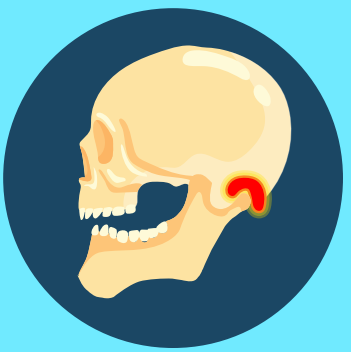
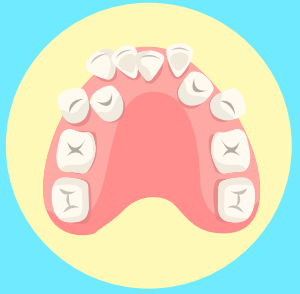
Should you choose to ignore bruxism, it will likely lead to one or more of the following:
Grinding and sleep-disordered breathing travel together: 1 in 4 people with sleep apnea also show signs of bruxism.
The occlusal guard, minus the dentist markup
/ə-ˈklü-səl/ · adjective
Of the biting surfaces of your teeth — where upper meets lower.
An occlusal guard won't cure bruxism — nothing you can buy will. What it does is take the hit for you: a custom-fitted barrier that keeps tooth off tooth while you and your dentist work on the cause. Here's what that buys you:
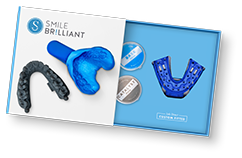
Order your kit
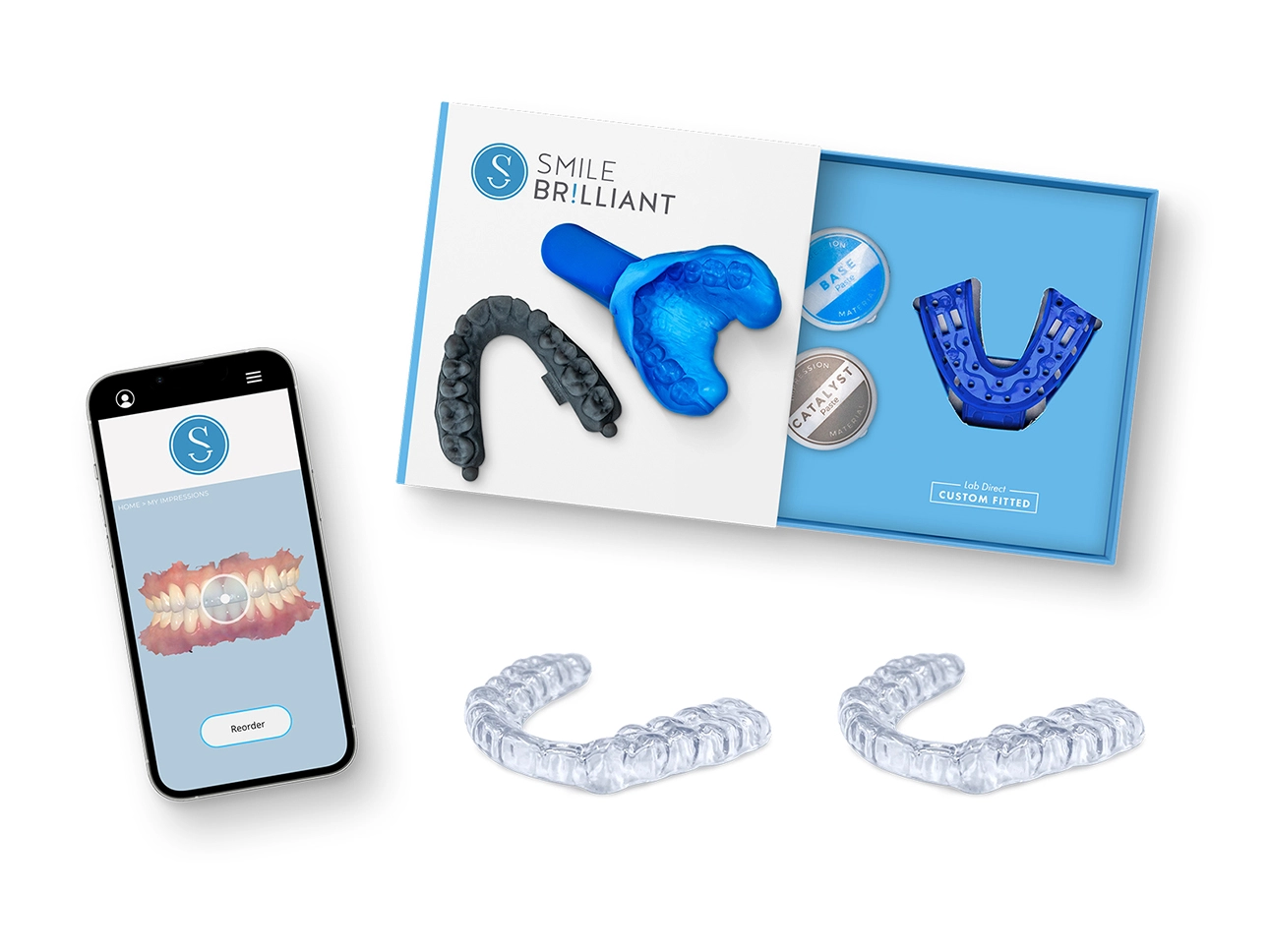
Your impression kit ships free, right to your door.
Mold at home
Dental-quality impressions in minutes — no appointment.
Lab crafts it
Our lab hand-makes a guard fitted precisely to your teeth.
Sleep protected
Wear it nightly and let your teeth and jaw finally rest.
Now check yourself against the list
Tick every sign you recognize and we'll estimate how hard you're grinding, then match a guard thickness to it.
Signs adapted from Smile Brilliant's guide to the signs of teeth grinding. This is a pointer, not a diagnosis — a dentist can confirm bruxism with an exam, or definitively with a sleep study.
Built from your bite, matched to your grind
Heavier grinders wear guards through faster — that's why we sell them in packs made to rotate, and in two thicknesses.

 FSA / HSA eligible
Every cause. One common treatment.
There's no quick fix for bruxism — treatment depends on what's driving yours. But lay the options out against the causes, and one row never goes empty.
| Cause | Night guard | Exercise | Dietary changes | Physical therapy | CBT |
|---|---|---|---|---|---|
| Stress & anxiety | — | — | |||
| Medications | — | — | — | — | |
| Stimulants | — | — | — | ||
| ADHD & autism | — | — | |||
| Neurological disorders | — | — | — | ||
| Food additives | — | — | — | ||
| Cancer treatments | — | — | — |
Treatment pairings summarized from the “Treating Bruxism” section of the guide. Root-cause treatments take time and discipline — the occlusal guard is the one on every row, because whatever the cause, it prevents the damage while you work on it.
"Congratulations for solving
my night guard issues."
This is the first time I've found a product that fits well, is pliable, and stays in my mouth. WOW — there were 4 of them… and they all fit!
for one rigid, dentist-made night guard — which broke the first time he dropped it. Over-the-counter guards never fit.
for Smile Brilliant's 4-guard system — custom-fitted from home impressions, pliable, and made to be rotated for years of use.
4.9 average · Trusted by 1,000,000+ smiles
FAQs
How is bruxism actually diagnosed?
A dentist checks for tooth wear and damage and asks about symptoms like jaw pain and headaches — or whether a sleep partner has heard grinding. For a definitive answer on sleep bruxism, a sleep study (polysomnography) can confirm it. Our self-check above is a useful pointer to bring to that conversation.
Standard 2mm or heavy-duty 3mm?
Standard 2mm suits light-to-moderate grinders — everyday protection that stays comfortable. Go 3mm if you're a heavy grinder: you've worn through guards before, wake with jaw pain most mornings, or checked 7+ signs on the self-check.
How do you fit it without seeing my teeth?
We see your teeth better than a quick appointment would: you take dental-quality impressions at home with our kit and mail them back postage-paid. Our dental lab hand-crafts your guard from those exact molds — and if an impression isn't usable, we send you a fresh kit.
How long does a guard last?
It depends on how hard you grind — heavy grinders wear through material faster. That's why our multi-packs exist: rotating between guards extends the life of each one, which is how customers make a 4-pack last for years.
Will it help my snoring or sleep apnea?
It may help — some occlusal guards help maintain an open airway, which can reduce snoring and improve sleep quality. And the overlap is real: 1 in 4 people with sleep apnea show signs of bruxism. But a night guard isn't a medical treatment for apnea — talk to your doctor about that.
Keep learning
The full guides and articles this page draws from, in the Smile Brilliant library.


Stop grinding. Start sleeping.
Your teeth can't fight 250 lbs of force — but they don't have to. Order tonight's protection now.
Find my night guardCustom-fitted · Dental-lab made · 100% Money-Back Smile Guarantee
